
One of the most important decisions when planning a trade show is where to locate your booth. Your booth location influences which booth format will work best, how much visibility you’ll gain, and how easily attendees can find your brand once they enter the exhibition hall.
The best location isn’t always the most expensive or the most obvious. While booths near the main entrance benefit from high visitor traffic, attendees are often still orienting themselves when they arrive. In contrast, secondary aisles and strategic intersections can generate equally valuable traffic at a lower cost.. Understanding how visitors actually move through the venue before you book your space is what separates a good location from one that just looks good on the floor plan.
The factors that matter most when choosing a location
Proximity to the main entrance
This is the zone with the most raw traffic, since everyone passes through it at some point, though that volume comes at a price: it tends to be the most expensive spot on the floor, and a good share of visitors who just walked in are still orienting themselves rather than looking for someone to talk to. It works well for brands with the budget to compete for that space and a visual hook strong enough to stop someone who’s on the move.
Aisle intersections
Booths located at major aisle intersections often provide one of the best traffic-to-investment ratios on the show floor. By the time visitors reach these areas, they have usually settled into the event and are more receptive to engaging with exhibitors.
Because these locations typically cost less than entrance booths while still offering excellent visibility, they are often an ideal choice for companies looking to maximize exposure without paying premium rates.
Proximity to anchor brands or event sponsors
Locating your booth near a major exhibitor or event sponsor allows you to benefit from the natural visitor traffic those brands generate. Most floor plans identify anchor exhibitors in advance, making it possible to evaluate these opportunities before reserving your booth.
The key is differentiation. Your booth should communicate a clear value proposition that attracts visitors without competing directly with the larger neighboring brand.
Service areas: food courts and restrooms
Food courts, cafés, and restroom areas naturally generate consistent foot traffic throughout the event. However, visitors in these areas often have a different mindset than those actively exploring exhibitors. It works well for passive brand exposure, and less so when the goal is deeper sales conversations.
A behavioral pattern worth knowing
Research on visitor behavior suggests that, when entering a large exhibition hall, attendees are slightly more likely to turn right than left. In practice, that means between two positions with equal traffic, the one on the right side of a main entrance tends to get slightly more attention in the first few minutes.
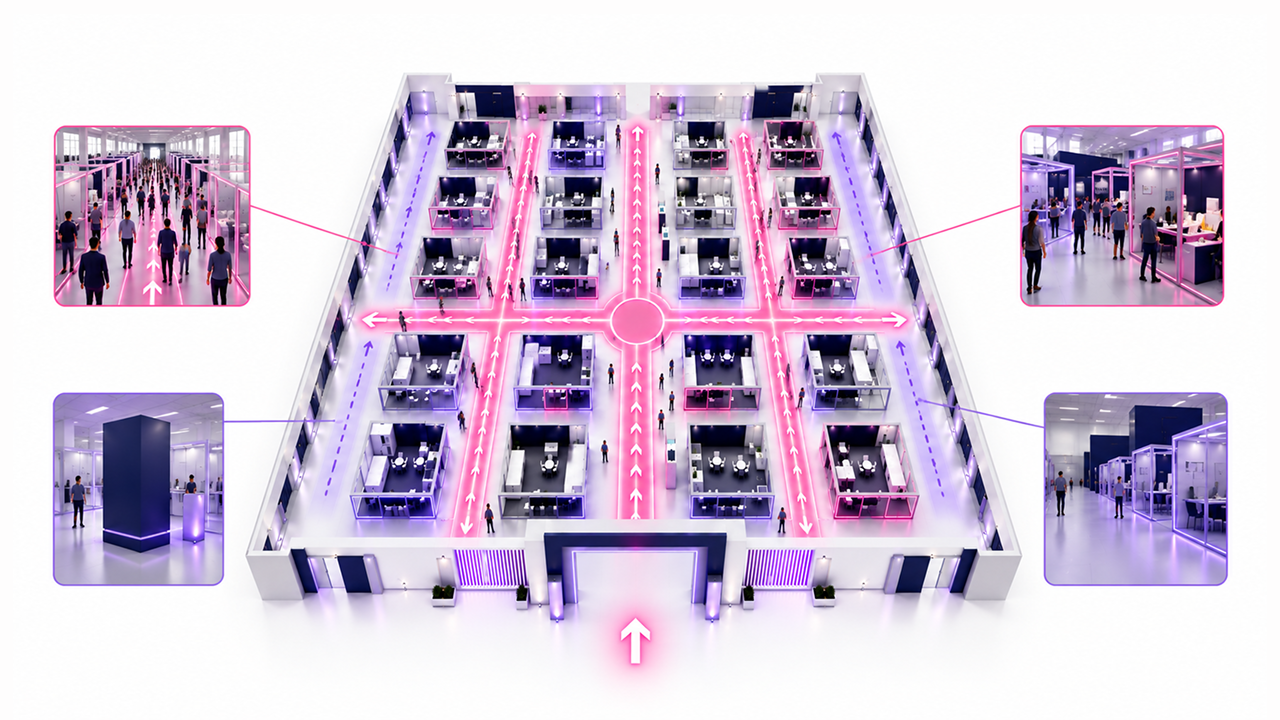
How to read the floor plan before you book
Before making a decision, evaluate the floor plan carefully and identify:
- The typical attendee route from registration to the conference rooms and food courts.
- The aisles with the highest foot traffic.
- Potential visual obstructions, such as columns, low ceilings, or structural elements that may reduce visibility.
- Whether the booth will have neighboring exhibitors on one or both sides, as this affects the most suitable booth configuration.
Tips for securing a good location on the trade show floor
The best positions sell out first, often with priority given to returning exhibitors, so if your brand has exhibited at the event before, it’s worth asking the organizer whether that priority applies to you. If it’s your first time, submitting a list of three to five preferred booth numbers instead of just one improves your odds without relying on a single option.
When the budget doesn’t stretch to a premium position, sponsoring a session, a coffee break, or a networking space can open the door to better locations without paying full price for a front-row booth, an option worth keeping on your radar.
How to communicate your booth location so clients can find you
Choosing the right location pays off more when your own clients and prospects know ahead of time that you’ll be there. Sending word early, rather than the day of the event, makes a real difference: the invitation can include the booth number, the hall, and, if the event offers one, a link to the interactive floor plan, since a map usually communicates faster than a written address. Prioritizing the accounts that matter most helps too, since a personal call or email to a key client, with a meeting proposed directly at the booth, tends to convert better than a generic social media post.
Repeating the message across more than one channel helps as well: social media to build anticipation in the weeks before, a newsletter for already-qualified contacts, and a section on the website or blog for anyone searching for the details after seeing the first announcement. Sharing that same information with the sales team staffing the booth helps every conversation start aligned from the first minute. And if the goal is for those conversations to lead somewhere concrete, it’s worth reviewing how to create booth experiences that generate real business opportunities.
How we handle this at Diper Exhibitions
Location and booth type get decided together, not separately, since an island booth in the best corner of the venue does little good if the real goal was private meetings rather than mass traffic. At Diper Exhibitions, we review the floor plan, the business objective, and the budget before recommending where and in what format to exhibit, as part of our method for supporting clients before, during, and after every show.

Frequently asked questions about trade show booth types in the United States
What’s the best location for a booth at a trade show?
There’s no single answer. Aisle intersections tend to offer the best traffic-to-cost ratio, while positions near the entrance or anchor brands offer more volume at a higher price.
Is it better to be near the entrance or in a mid-floor aisle?
It depends on your goal. The entrance delivers more raw traffic, but many visitors there are still getting oriented, while a mid-floor aisle tends to have more receptive visitors at a lower cost.
Is being near a competitor good or bad?
It can be both: you benefit from the traffic they draw, but you need a clear differentiation plan to stand out next to a competitor with a bigger or flashier booth.
When should I book my booth location?
As early as possible, since the best positions sell out first and many events give priority to returning exhibitors.
How do I know if a location is a dead zone before booking it?
By checking the real visitor flow on the floor plan rather than just its apparent position. Dead-end aisles, areas behind columns or large structures, and spaces far from the routes between registration, sessions, and food tend to see less traffic than they appear to on paper.