Choosing the right booth for a trade show is one of the most important decisions you’ll make before participating in an event. The type of booth you select directly influences how visitors perceive your brand, how your team interacts with prospects, and how many business opportunities you can generate during the show.
The best booth isn’t always the biggest or the most expensive. It’s the one that helps your team connect with the right audience, communicate value quickly, and turn event conversations into measurable results.
Start with your booth’s business goal
From a commercial standpoint, the booth should be viewed as a sales tool. It’s not just about creating an attractive space—it’s about designing an environment that encourages meaningful conversations, helps your sales team engage visitors more effectively, identify opportunities, and guide prospects through the customer journey throughout the event.
That’s why, before defining the design, it’s key to ask: do we want to attract volume of visitors or more qualified meetings? Do we need to showcase product, build trust, close deals, receive distributors, or position the brand in a new market? Each answer changes the way the booth should be designed.
If your goal is to generate qualified contacts, the booth should make it easy for attendees to walk in, ask questions, scan a QR code, schedule a meeting, or speak with your sales team. If your goal is to increase brand visibility, you need impactful graphics, clear messages, and visual presence from different points within the venue. If your goal is to educate about a product, the booth should include demo areas, screens, counters, shelving, and enough space for interaction.
Connect every booth decision to a measurable outcome
An effective booth must answer one key question: what do you want the visitor to do after they approach your booth?
Every design decision should guide visitors toward a specific action: schedule a meeting, request a quote, attend a demo, or start a conversation with your sales team. When the visitor journey is designed with that goal in mind, the experience becomes far more effective.
At Diper Exhibitions, we start every project by understanding your goals, target, timeline, and expected outcomes. This allows us to recommend a solution that works as a strategic tool, not just an attractive exhibition space.
Choose the right booth size for your event strategy
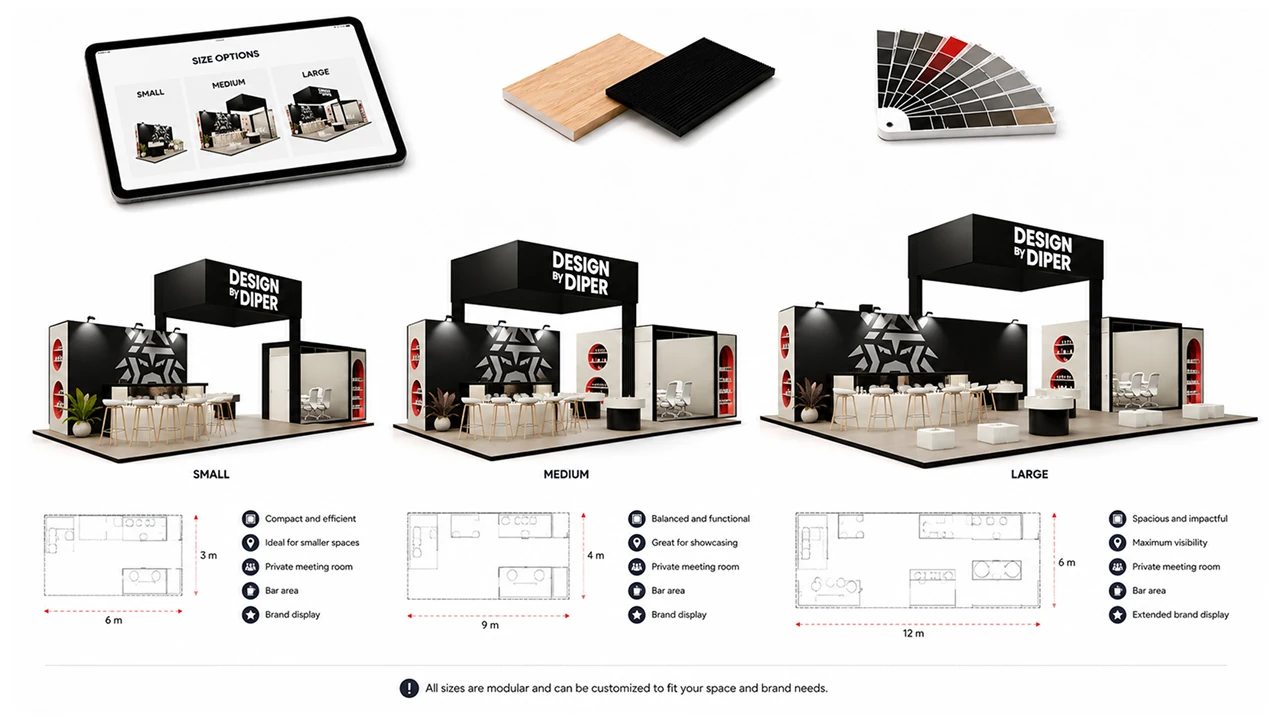
Booth size affects visibility, visitor flow, the number of staff needed, budget, and interaction capacity. A 10×10 booth may be enough for a specific campaign, while a 10×20, 20×20, or larger format (like island booths) may be better suited for companies that require meeting areas, product demonstrations, or greater brand visibility.
From a commercial standpoint, booth size should also be defined by the team’s actual capacity to attend to visitors and generate quality conversations. A large space without a clear strategy can lose momentum, while a more compact, well-thought-out, and well-staffed booth can deliver better business results.
When to choose a 10×10 booth
A 10×10 booth is a good option when your company needs a compact, professional, and cost-effective presence. Its size encourages more direct communication with visitors and allows you to focus attention on a single main message without distractions. It’s ideal for lead generation, market testing, product launches, and events where your value proposition can be communicated quickly.
To get the most out of this format, avoid visual clutter. Prioritize a clear value proposition, a highly visible key message, and a specific call to action. A clean, well-organized design not only improves brand perception but also makes interaction with visitors easier and contributes to higher-value conversations.
When a larger booth makes sense
A larger booth is recommended when your sales process requires deeper conversations, live demonstrations, display of multiple products, or private meeting areas. If your company participates in major industry trade shows or competes with high-visibility brands, a larger booth can reinforce credibility and attract more attention.
Formats like 10×20, 20×20, or island booths offer the possibility of creating multiple engagement areas, including a welcome space, demonstration zone, private meeting rooms, and lead capture stations. This allows for a more complete visitor experience and more opportunities for your sales team.
Decide between modular or custom booth
The best solution depends on your budget, event schedule, logistics, and branding objectives.
A modular booth offers great versatility. Its components can adapt to different sizes and configurations, making it a very practical option if you participate in several trade shows a year and need a solution that fits different spaces without losing your brand essence.
A custom booth is the best choice when your company needs a unique brand experience. This type of solution is ideal for product launches, high-impact trade shows, and brands that want to stand out through a memorable and strategic space. Companies seeking a more exclusive presence often choose custom booths because they allow the space to be built around visual identity, visitor flow, product interaction, and business goals.
Here’s a key fact: most of the booths we design and produce at Diper Exhibitions are rentals, even the fully custom ones. Choosing rental gives you much more freedom: forget about storage, maintenance, and reverse logistics costs. Plus, you can update the design for each event without committing to a permanent structure, making your investment much smarter.
How Diper Exhibitions helps you choose the right format
At Diper Exhibitions, we don’t believe in one-size-fits-all solutions. Before recommending a booth, we evaluate your objectives, available space, event schedule, installation requirements, branding expectations, and budget.
If you participate in several trade shows a year, a modular and versatile booth can offer you better long-term value. If your brand needs a premium presence for a key event, a custom rental booth can generate a much greater impact without tying up your long-term budget.
Design the booth with the visitor experience in mind
A successful booth is designed with the attendee in mind. Visitors walk through an environment full of stimuli, compare many brands, and decide in seconds where to stop. That’s why your booth must communicate value immediately.
This means the message should be clear, the space should feel open, and the brand should be recognizable from a distance. The goal is to reduce friction and make it natural for people to approach your team.
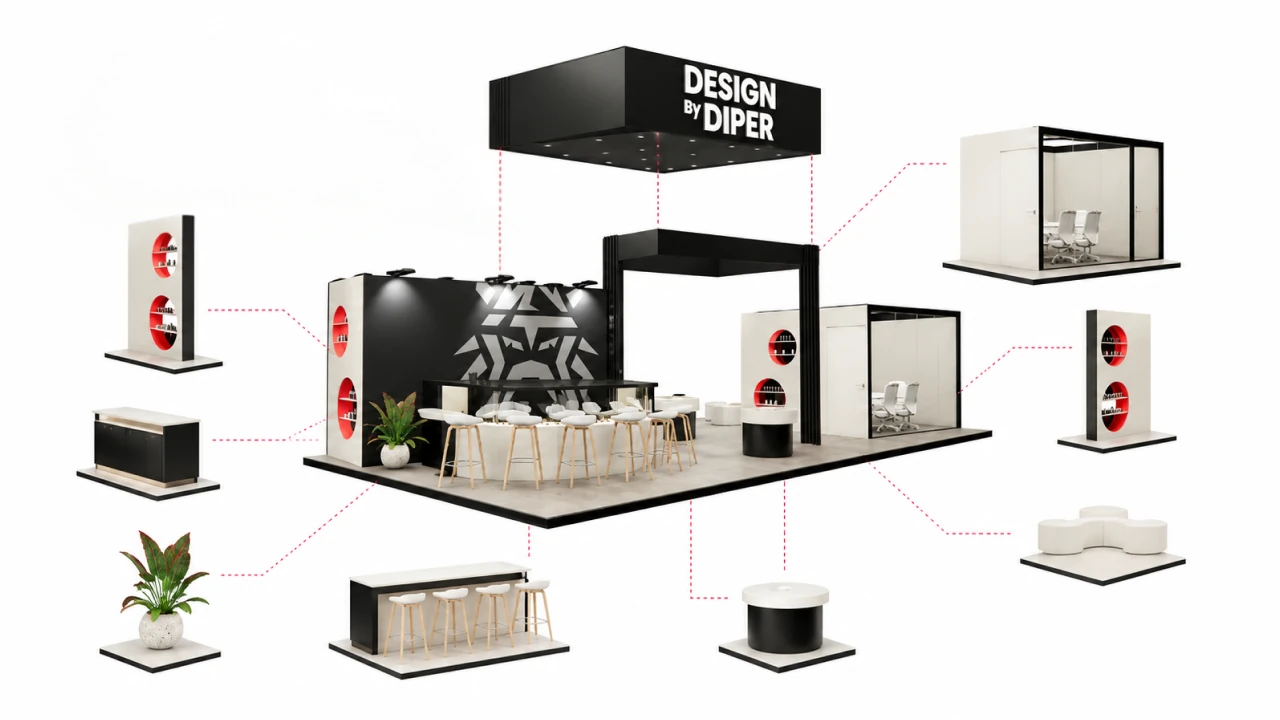
An effective booth may include branded graphics, product displays, digital screens, strategic lighting, reception counters, interactive demonstrations, lead capture tools, and a clearly defined visitor flow. However, every element should serve a purpose. A cluttered booth can overwhelm visitors, while a design built around your business objectives encourages stronger engagement.
Keep the message simple and easy to understand
Your booth should quickly answer three questions: who do you help, what do you offer, and why does it matter?
Instead of filling graphics with lots of text, focus on a powerful headline, a supporting image, and a clear call to action. Visitors shouldn’t have to struggle to understand your value proposition.
This is where great trade show booth design makes the difference. The design should guide attention, facilitate conversations, and help your team move the visitor to the next step.
Plan your budget considering the entire event
From a commercial standpoint, the budget should be analyzed as a complete investment, not as an isolated construction cost. A booth may seem more economical at first, but if it’s not well thought out, it can generate additional expenses in assembly, transportation, services, last-minute changes, or poor performance during the show.
The booth budget should include more than just the main structure: design, graphics, flooring, lighting, furniture, transportation, installation, dismantling, storage, electrical services, lead capture systems, team travel expenses, and promotional materials.
The cheapest booth isn’t always the most profitable. A solution that’s difficult to transport, complicated to assemble, or doesn’t adapt to multiple scenarios can generate additional costs. On the other hand, a booth that works for several events and can be updated with new graphics can offer greater long-term value.
At Diper Exhibitions, we help companies evaluate booth investment from a practical and strategic perspective. The right booth should respond to the current event but also support future opportunities.
Think beyond a single trade show
If your company plans to participate in several trade shows in different countries, it can be much more convenient to work with an agency that offers rental solutions in each market, avoiding excessive transportation and storage costs. At Diper Exhibitions, we have a presence in the United States, Colombia, Brazil, and Argentina, allowing us to produce and install booths locally, reducing logistics costs and response times.
If your event calendar is stable and in the same region, it may be worth investing in a modular, versatile system that’s easy to update. The goal is to choose a booth that supports your marketing strategy without creating unnecessary logistical complications.
Use the booth as a lead capture and follow-up tool
A trade show booth should help create real business opportunities. That’s why it should support the capture, qualification, and follow-up of prospects.
Before the event, determine exactly what information your team should collect from every visitor, including their name, company, job title, email address, product interest, buying timeline, budget, and agreed next steps. Your booth should make this process fast and intuitive.
After the event, follow-up should happen soon and in a personalized way. The best booth experience continues after the trade show, when your team turns conversations into meetings, proposals, and sales.
What makes a trade show booth effective
A booth is effective when it helps visitors immediately understand your brand while enabling your sales team to start better conversations, qualify opportunities, and confidently follow up after the event.
The booth should function as a marketing and sales tool, not just as a visual display. It attracts the right audience, communicates value quickly, offers a clear experience, facilitates qualified conversations, and helps the sales team follow up with confidence.
Frequently asked questions about choosing a trade show booth
What type of trade show booth is best for my company?
The best booth depends on your goals, budget, event size, audience, and participation frequency. A small company may benefit from a 10×10 booth, while a brand launching a major product or seeking a premium presence may need a larger modular or custom booth.
Is it better to rent or buy a trade show booth?
Renting is usually better for companies that participate in few events, need flexibility, or want a solution for a specific show. Buying may be more convenient for companies that exhibit frequently in the same region and need their own structure. However, if the trade shows are in different countries, local rental avoids transportation costs and simplifies the entire logistics.
How can I make my booth stand out at a trade show?
You can make your booth stand out with clear branding, good lighting, simple messages, an open layout, interactive elements, and a clear reason for visitors to stop. A professional booth should be recognizable from a distance and generate interest as people approach.
Why work with Diper Exhibitions?
Diper Exhibitions helps companies plan, design, and execute trade show booths with a strategic, commercial, and operational approach. It’s not just about building an attractive space, but about creating a solution aligned with the brand’s goals, budget, market, and event type.
With over 38 years of experience in the industry, more than 12,000 installed projects, in-house teams, and operations across the United States, Colombia, Brazil, and Argentina, we support our clients from the first idea to the final implementation. Our goal is for every booth to function as a real tool for positioning, audience connection, and business opportunity generation.