At a trade show, every brand is competing for the same thing: attention.
But attention alone doesn’t generate business. What turns a visit into a real opportunity is what the visitor experiences inside your booth how they enter, what they feel, what they understand, and what they decide to do after leaving.
That’s the difference between a booth that impresses and one that sells.
At Diper Exhibitions, we see it in every project: the brands that get the best results at trade shows aren’t necessarily the ones with the biggest booth or the highest budget. They’re the ones that design the experience with the same intention they bring to their business strategy. You can explore how we approach that process in every project we take on.
Why booth experience is a sales tool
When we talk about the experience inside a booth, we’re not talking about decoration or visual effects. We’re talking about something much more concrete: the journey a visitor takes from the moment they enter until they decide to stay and talk or keep walking.
That journey doesn’t happen by accident.
Every element inside the booth, the layout, the visible messages, the interaction points, and the conversation areas, directly influences the visitor’s behavior. And that behavior determines how many real business opportunities are generated during the event.
A booth that isn’t designed to guide that journey may attract attention, but it rarely generates meaningful conversations. And without meaningful conversations, there are no leads. And without leads, there is no ROI.
The 3 phases of a trade show booth experience that generates business
At Diper Exhibitions, we understand the experience inside a booth as a three-phase process. When all three are well designed, the result is a space that doesn’t just look good — it performs as an opportunity generation machine.
Phase 1: Impact
Everything starts before the visitor enters the booth. From the aisle, in a matter of seconds, they decide whether it’s worth stopping or keep walking.
In those first seconds, the booth must communicate two things clearly: who you are and why it should matter to the person passing by.
This isn’t achieved with more information. It’s achieved with more clarity. A strong visual element, a visible and direct message, an architecture that invites entry. Impact is not noise — it’s immediate relevance. Understanding how visual storytelling works inside a booth is one of the most effective ways to nail this phase.
Phase 2: Discovery
Once the visitor enters, the objective changes. It’s no longer about capturing attention. It’s about demonstrating value.
This is the most underestimated phase in booth design. Many brands fill the space with information, screens, and materials without considering how visitors actually process them. The result is a visually overwhelming space where no one knows where to begin.
A well-designed experience guides the visitor naturally: first they understand what the brand does, then why it matters to them, and finally how it applies to their specific situation. That process can happen through a live demonstration, a product interaction, well-placed audiovisual content, or simply a conversation well initiated by the team.
The key is that discovery isn’t improvised, it’s designed. And when it’s well designed, the visitor moves to the next phase with a question in mind, not uncertainty.
Phase 3: Connection
Connection is the moment when the visitor decides to stay and engage. It’s the point where a visit becomes a real business opportunity.
For this to happen naturally, the space must support it. Clearly defined areas for brief meetings, conversation zones that offer privacy without isolation, and information capture points integrated into the flow of the journey.
When the space doesn’t facilitate connection, the team ends up forcing it and that rarely works at a trade show. Visitors feel pressured and look for a way out.
On the other hand, when the design creates the right conditions, conversations happen organically. The team doesn’t have to chase the visitor they simply need to be ready for the conversations the space has already set in motion.
What happens when all three phases are aligned
The effect of having all three phases well designed isn’t just qualitative, it’s completely measurable.
More visitors stop. A greater proportion enters the booth. The average time spent inside increases. Conversations are longer and more relevant. The leads captured are of higher quality. And post-show follow-up starts from a stronger foundation because the visitor already has context, already trusts, and already has a concrete reason to continue the conversation.
That chain of effects is what transforms a trade show from an expense into an investment with demonstrable returns. We go deeper into that measurement framework in our article on how to turn your trade show participation into a strategic investment.
The most common mistake: designing the booth and forgetting the experience
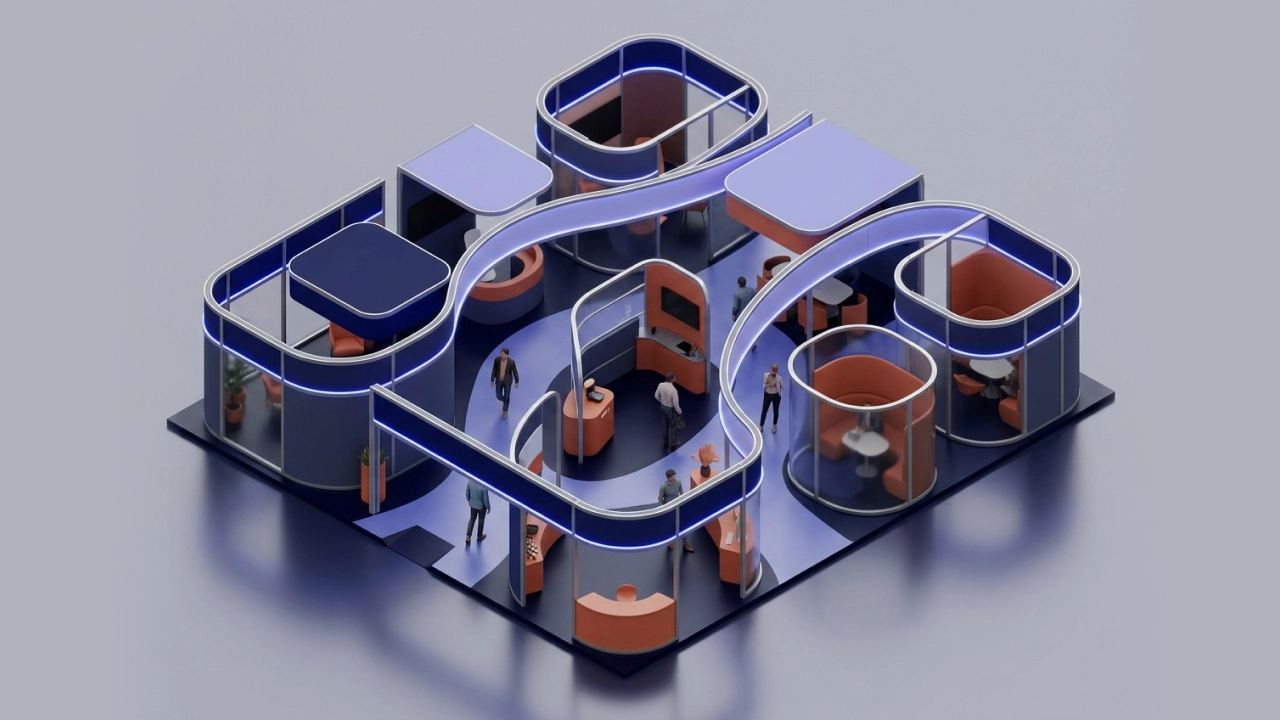
Many companies invest time and budget in the visual design of the booth and very little in thinking about what’s actually going to happen inside it.
They define colors, materials, and lighting. They produce the space with quality. They arrive at the trade show with a booth that looks great.
But they didn’t define how a conversation is going to start. They didn’t train their team to qualify leads. They didn’t establish zones with clear purposes. They didn’t think about how to capture information efficiently.
The result is an attractive booth that doesn’t generate the expected results and an investment that’s hard to justify. If you want to avoid this from the planning stage, our stress-free trade show planning checklist covers exactly how to set that up before the event.
At Diper Exhibitions, we work differently. Before designing any visual element, we define what should happen inside the booth: what the visitor should feel when they enter, what they should understand in the first thirty seconds, what conversations should take place, and how the generated opportunities will be captured.The design comes after ,and when it does, it has a clear purpose behind every decision. Browse our portfolio to see what that looks like in practice.
The experience doesn’t end when the trade show closes
A well-designed experience has an effect that goes beyond the event. The visitor who lived something memorable inside your booth doesn’t just remember you — they come looking for you afterward.
That completely changes the dynamics of post-show follow-up. Instead of chasing cold leads, your team is responding to people who already have a connection with the brand, who remember what they experienced, and who have a concrete reason to continue the conversation.
That’s the true value of designing the experience with intention: not just what happens during the trade show, but what it generates afterward. Hear how other brands have experienced this firsthand in our client testimonials.
The booth is the space, the experience is the product
Trade shows remain one of the most powerful tools for generating business when used well.
And using them well starts with understanding that the booth is not the final product. The experience that happens inside it is.
At Diper Exhibitions, we design that experience with the same precision with which we design the space. Because in the end, what the visitor remembers is not how your booth looked.
They remember how you made them feel.