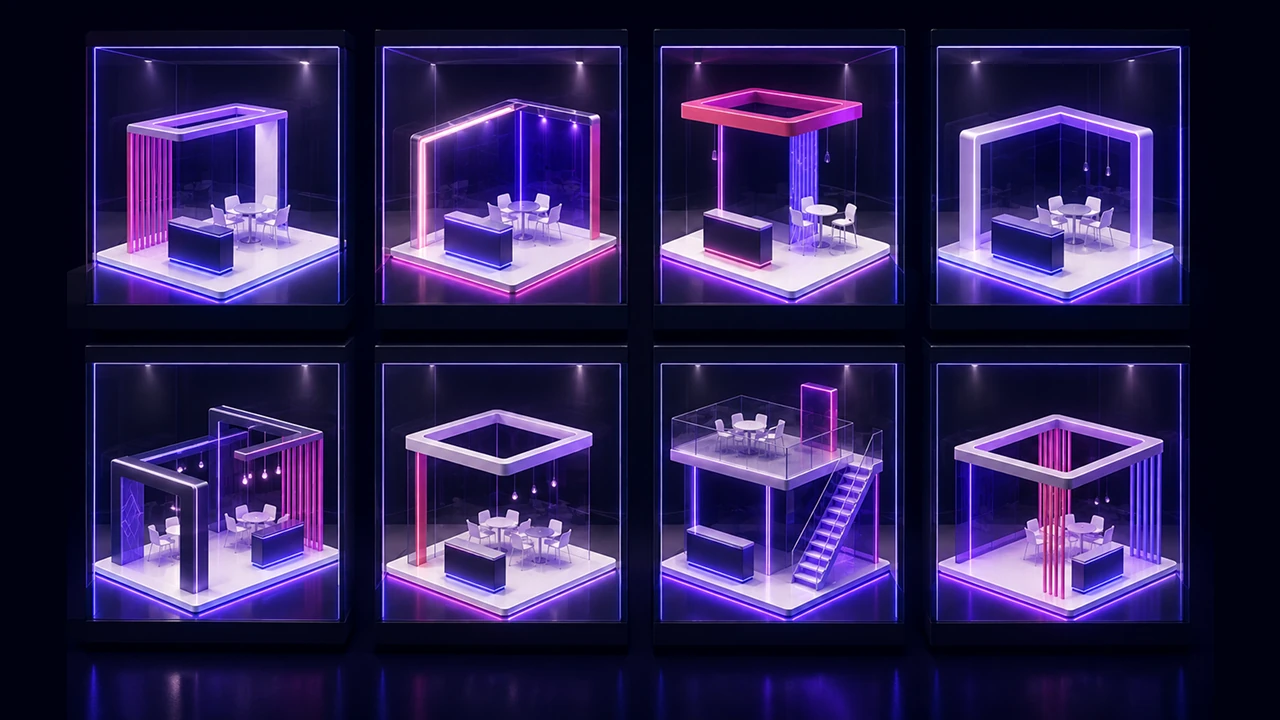
There are 8 main types of trade show booths in the United States: inline, corner, end-cap, peninsula, split island, island, and perimeter. They differ based on their location within the exhibition hall, the number of sides open to attendees, and the level of investment required. Choosing the right booth depends on your business objectives, budget, and the amount of visitor traffic you want to attract at U.S. trade shows.
Selecting the right booth type is one of the most important decisions when planning your participation in a U.S. trade show.. Your booth configuration influences visibility, visitor flow, engagement opportunities, and operational efficiency, all factors that directly impact your event results.
If this is your first time exhibiting in the United States, you may want to review how to select the right trade shows for your market launch first.
The 8 types of trade show booths in the USA
1. Inline booth: the most common and accessible format in the U.S. market
An inline booth, also known as a linear booth, is positioned within a row of exhibitors. It has neighboring booths on both sides, a shared back wall, and is open only toward the front aisle. It is the standard format in most convention halls across the United States.
Advantages: Controlled investment, simple to build, and a back wall that is ideal for direct branding.
Disadvantages: Visibility is limited to a single aisle, making visitor traffic highly dependent on the booth’s location within the exhibition hall.
Ideal for: First-time exhibitors, companies with limited budgets, and brands with a clear, focused commercial message.
2. Corner booth: visibility from two sides
A corner booth is located at the end of a row is open to both the front aisle and one side aisle, providing visibility from two directions.
Advantages: Greater visibility than an inline booth and improved visitor flow; it attracts attention from two directions.
Disadvantages: Higher rental cost and the need for a booth design that performs effectively from multiple viewing angles.
Ideal for: Brands looking to increase visibility with a moderate budget, without upgrading to a larger booth format.
3. End-cap booth: exposure from three aisles
An end-cap booth is positioned at the end of two rows of booths and is open toward three aisles, making it one of the formats with the greatest potential for visitor traffic at U.S. trade shows.
Advantages: Maximizes points of contact and allows for separate registration, demonstration, and visitor-service areas.
Disadvantages: Height restrictions may apply to avoid blocking the view of neighboring booths, requiring careful design.
Ideal for: Companies that need to attract large numbers of visitors. If your objective is to generate qualified contacts, it is advisable to combine the booth with a follow-up strategy. Learn more about how to create booth experiences that generate real business opportunities.
4. Peninsula booth: versatility for meetings and demonstrations
A peninsula boothis open on three sides and shares a back wall with another booth, offering an effective balance between open visitor access and semi-private spaces.
Advantages: Ideal for hospitality areas, private meetings, and simultaneous product demonstrations.
Disadvantages: Requires strategic visitor-flow planning to prevent attendees from becoming disoriented.
Ideal for: Technical demonstrations, immersive brand experiences, and in-depth conversations with prospective customers.
5. Split island booth: a large format for extensive portfolios
A split island booth is a large-format configuration that is open toward three aisles and connected at the back to another exhibitor. In practice, it consists of two peninsula booths positioned back-to-back, creating a spacious layout with excellent visitor access.
Advantages: Provides ample space for multiple functional areas, including meeting rooms, product demonstrations, brand activations, presentations, and customer service.
Disadvantages: More complex logistics than other formats and coordination with the neighboring exhibitor for the shared back-wall design.
Ideal for: Companies with multiple product lines or complex solutions that need to be presented within a single space. (The need for rigging, high electrical capacity, or overhead support depends on the specific booth design, not on the split island format itself).
6. Island booth: maximum visibility and 360-degree impact
An island booth is an independent space that is open on all four sides and has no shared walls. It is the format with the greatest visual impact in exhibition halls across the United States.
Advantages: Unobstructed visibility from every direction and complete freedom to create a fully customized visitor experience.
Disadvantages: Higher investment, as all four sides must be designed and finished to the same quality standard.
Ideal for: Immersive product launches, brand positioning, and companies seeking to project leadership within their industry in the U.S. market.
7. Double deck booth: maximize space with two levels
A double deck booth is a two-story exhibit that takes advantage of the available height in U.S. convention centers to increase usable space without expanding the booth footprint.
Important note: Unlike the other formats—inline, corner, end-cap, peninsula, split island, island, and perimeter—which mainly describe the booth’s location and number of open sides, double deck refers to a two-level construction solution that can be applied to different configurations, such as island or peninsula booths.
Advantages: Adds space for VIP lounges, private meeting rooms, offices, or hospitality areas without requiring additional floor space, while creating a strong visual presence on the show floor.
Disadvantages: High engineering, safety, and certification costs, as well as special venue approvals commonly required under U.S. convention regulations.
Ideal for: Meetings with strategic partners, VIP customer service, and brands seeking to differentiate themselves with an imposing structure.
8. Perimeter booth: a location along the exhibition hall wall
A perimeter booth is located against an exterior wall of the exhibition hall and has a single open front.
Advantages: It may provide greater rear-wall height than a traditional inline booth, depending on venue regulations. The back wall also provides privacy and complete control over the booth background. Its price is not always the lowest, as it depends on the event and the specific location reserved along the perimeter wall.
Disadvantages: One-directional visitor flow; its performance depends on the specific location and the actual traffic along that perimeter aisle.
Ideal for: Brands looking to take advantage of a perimeter location and the potential for greater back-wall height. As with any booth type, its effectiveness ultimately depends on the booth’s location and visitor traffic.
How to choose a booth based on your business objective in the USA
| Business objective | Key considerations | Recommended formats |
| Large-scale lead generation | Maximum traffic exposure and quick points of contact | End-cap, corner |
| Sales and business meetings | Spaces for private conversations and follow-up | Peninsula, double deck |
| Brand positioning | Visual impact and design freedom | Island, double deck |
| Technical demonstrations | Areas for explaining complex products | Peninsula, island |
| Networking with partners | Balance between openness and privacy | Double deck, peninsula |
| Limited budget | Resource optimization without sacrificing functionality | Inline, perimeter |
| First participation in the USA | Validate the market, event, or product before scaling | First define what you want to validate: the U.S. market, the specific trade show, the product, or your ability to generate meetings. The appropriate format should be selected based on that answer. |
2026–2027 trends redefining trade show booth design in the USA
Choosing the format is only the first step. The design developed within that format is what makes the difference in 2026–2027 between a booth that merely decorates the exhibition hall and one that converts visitors in the competitive U.S. trade show market. These are the trends shaping the industry:
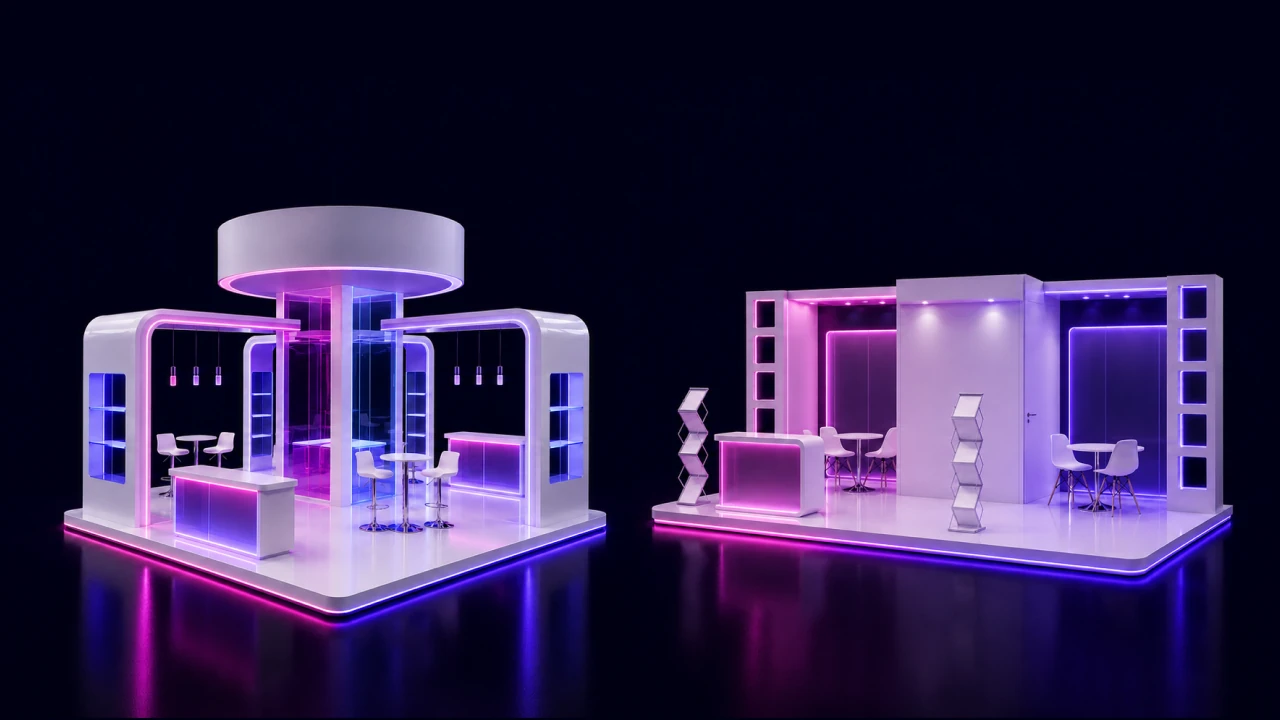
Modularity and reuse. More brands are demanding structures that can be reconfigured between formats, from a 130 ft² corner booth to a 390 ft² island booth, without rebuilding everything from the ground up. This reduces the cost per event for companies participating in multiple trade shows each year across different U.S. states.
Experience matters more than aesthetics. According to Event Marketer’s 2026 EventTrack survey, brands are prioritizing one-on-one meetings to support sales teams, smarter data collection, and more engaging demonstrations over the visual appearance of the booth. In fact, looking or merely appearing sustainable ranked last among 2026 priorities. This favors formats with conversation areas—such as peninsula and double deck booths—even over visually striking formats like island booths.
Technology integrated into the visitor journey. Touchscreens, augmented reality, and digital signage are no longer optional additions. They have become part of the visitor journey. In large formats such as island and split island booths, this means interactive demonstration zones. In smaller formats such as inline and corner booths, digital displays can replace printed graphics.
This context reinforces an important point from the previous table: the right booth is not necessarily the largest or most visually impressive. It is the one that best supports the experience your brand wants to provide in the U.S. market.
How does Diper Exhibitions select the right booth in the USA?
After 39 years of designing and producing trade show booths in different markets across the Americas, including the United States, we know that choosing the right space is just as important as designing it. At Diper Exhibitions, we do not believe in a one-size-fits-all answer. We analyze five key factors to determine the right booth format for each brand in the North American trade show market:
- Business objective: Are you looking to generate leads, position your brand, close sales, or network in the USA?
- Operational capacity: How many visitors will your team serve at the same time? How much space does your staff need?
- Required areas: Do you need private rooms, demonstration areas, activation spaces, or hospitality zones?
- Location within the exhibition hall: Will the booth be close to entrances, the main stage, or a secondary aisle?
- U.S. venue regulations: What height limits and restrictions are established in the convention center’s exhibitor manual?
With our own teams and production capabilities, we manage design, production, logistics, installation, and dismantling, while also supporting multi-show programs with reusable solutions. We understand local regulations and operations in different markets throughout the Americas, including major U.S. exhibition destinations such as Las Vegas, Chicago, and Orlando.
At Diper Exhibitions, we believe that support does not end when the booth format is selected. We follow a method that covers the period before, during, and after every U.S. trade show so that the investment can produce measurable results.
Discover all of Diper Exhibitions’ trade show booth services and learn how we can help design a space that drives results in the U.S. market.

Frequently asked questions about trade show booth types in the United States
How many types of trade show booths are there in the USA?
There are 8 main types: inline, corner, end-cap, peninsula, split island, island, double deck, and perimeter. Each one has advantages and disadvantages depending on the objective and budget.
It is important to note that double deck refers to a two-level construction solution that can be applied to different configurations, unlike the other formats, which mainly describe booth location and the number of open sides in U.S. exhibition halls.
Which type of booth is best for my company in the U.S. market?
There is no single answer. It depends on your business objective, budget, team capacity, location, and type of event in the United States. At Diper Exhibitions, we analyze these factors to recommend the most appropriate format.
When should I choose an island booth in the USA?
An island booth is suitable when you want maximum visibility, strong brand impact, and complete design freedom. It is ideal for launches and immersive experiences at major trade shows such as CES or NAB Show.
When is a double deck booth worth the investment at a U.S. trade show?
It is worth considering when you need to maximize usable space for VIP rooms, private offices, or meetings with strategic partners without increasing the booth footprint, while taking advantage of the permitted height in U.S. venues.
What do you recommend for a first trade show participation in the United States?
For a first participation in the USA, we recommend defining what the company wants to validate first: the North American market, the specific trade show, the product, or its ability to generate meetings. The appropriate format should then be determined based on that answer.
If the objective is to test the market with a moderate investment, an inline or corner booth may be a good option. However, if the U.S. launch requires more ambitious positioning or an established meeting schedule with key customers, an island or peninsula booth may be more appropriate from the beginning.
What is the difference between a modular and a custom booth in the U.S. market?
A modular booth uses reusable prefabricated components. It is more affordable, faster to install, and adaptable, making it suitable for trade shows in different states.
A custom booth is designed from the ground up for the brand. It is more expensive, but it provides a unique appearance and greater visual impact in the competitive U.S. market.
Which type of booth generates the most business leads at U.S. trade shows?
Formats with more open sides—such as end-cap, corner, and island booths—typically attract more spontaneous traffic in North American exhibition halls.
However, converting that traffic into real business opportunities also depends on the experience inside the booth, not only on the format.